
May 7, 2026
ReTune in Management & Krankenhaus: Personalized Neuromodulation and AI-Guided DBS
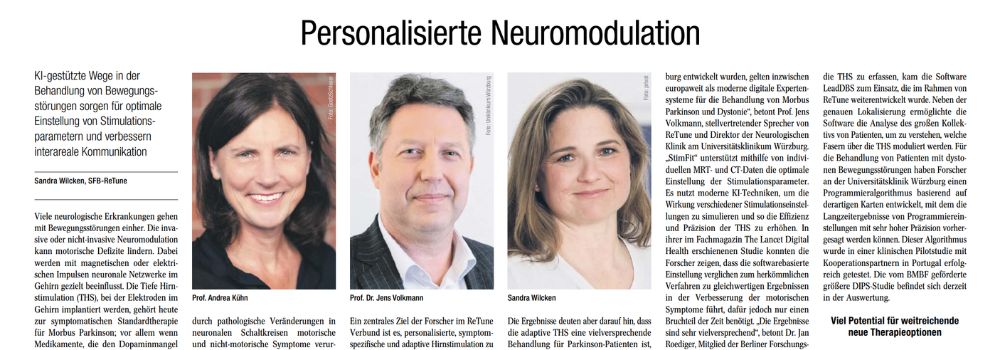
Prof. Andrea Kühn and Prof. Jens Volkmann are featured in a new article in Management & Krankenhaus, highlighting the consortium’s advances in AI-assisted deep brain stimulation programming and adaptive neuromodulation for Parkinson’s disease and other movement disorders.
From Network Disorder to Intelligent Stimulation
Central to ReTune’s approach is the understanding of neurological diseases as network disorders, in which pathological changes in neural circuits drive both motor and non-motor symptoms. Researchers aim to develop adaptive DBS systems that read brain signals in real time and adjust stimulation accordingly. As of January 2025, the first patients in Berlin and Würzburg are being treated with such flexible implants. A pilot study published in NPJ Parkinson Disease in August 2025 reported meaningful improvements in motor function and well-being compared to conventional stimulation.
AI Algorithms for DBS Programming
Two algorithms developed within ReTune, StimFit at Charité Berlin and DIPS at the University of Würzburg, have become recognized across Europe as advanced digital expert systems for DBS programming. StimFit uses individual MRI and CT data to simulate stimulation effects before they are applied to the patient. A randomized trial published in The Lancet Digital Health showed that StimFit-suggested settings matched standard clinical outcomes in a fraction of the time. For dystonia, a Würzburg-based algorithm predicting long-term programming outcomes has been successfully piloted; the larger DIPS study is currently under evaluation.
Looking ahead, ReTune’s second funding phase through 2028 focuses on network dynamics in everyday contexts and context-sensitive stimulation strategies. “We want to develop DBS into an intelligent brain-computer interface that not only suppresses pathological states but also supports physiological brain activity in the long term,” said Prof. Jens Volkmann. Prof. Kühn added: “The close collaboration between neurology, engineering, computer science, and neuroscience in the ReTune project ensures that technical innovations with high clinical relevance are rapidly put into practice to significantly improve patients’ quality of life.”
Read the full article (PDF in German)
© Picture: Management & Krankenhaus, 4/2026