Aug 15 , 2026
Öykü Okur on Mapping Movement-Related Brain Oscillations at FENS Forum 2026
What happens across the brain when we start to move? At FENS Forum 2026 in Barcelona, ReTune researcher Öykü Okur presented work mapping movement-related brain oscillations – signals that are also relevant to disorders such as Parkinson’s disease and dystonia.
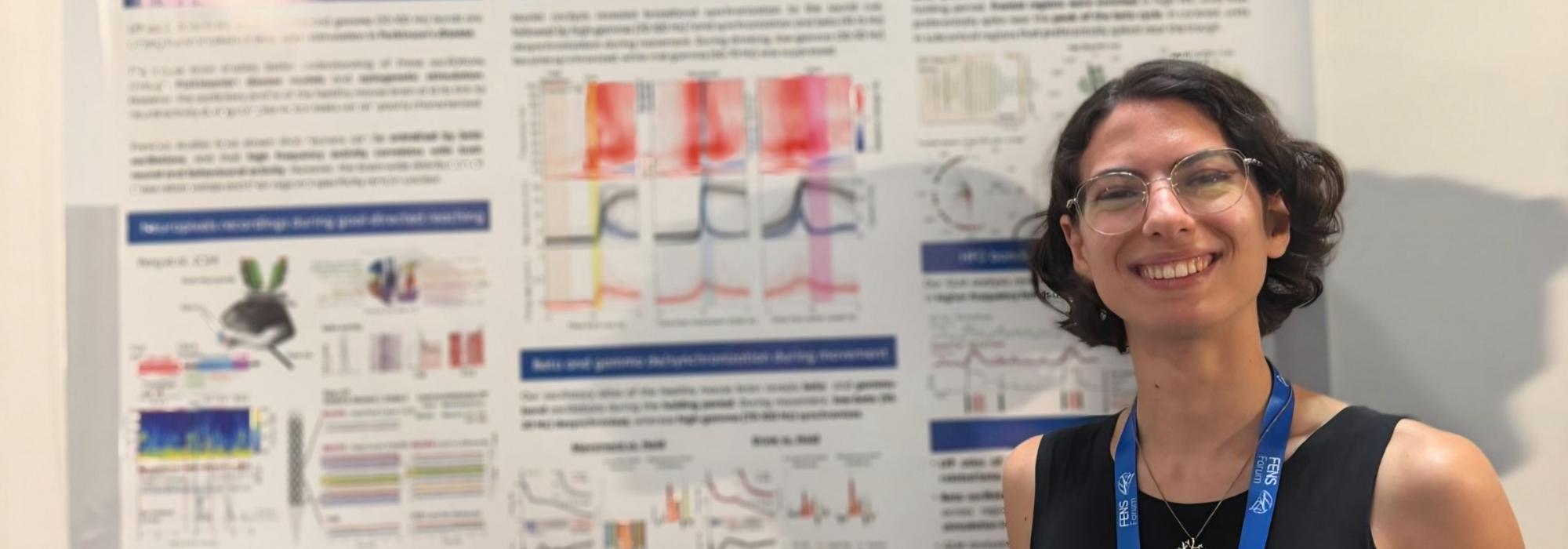
From July 6 to 10, 2026, the FENS Forum brought thousands of neuroscientists to Barcelona, Spain, for one of Europe’s largest neuroscience conferences. Among the ReTune researchers presenting was Öykü Okur, M.Sc., PhD candidate in ReTune Project A04 at Charité, Berlin. Her work uses Neuropixels recordings to investigate neural activity and local brain oscillations simultaneously across more than ten brain regions during movement. We asked her about her research, what she took away from FENS, and why understanding these brain rhythms could ultimately matter for people with movement disorders.
What did you present at FENS, and which other topics caught your attention?
I presented a poster on the mapping of movement-related oscillations, rhythmic patterns of brain activity, across the healthy mouse brain. My presentation highlighted the Neuropixels recording technique used in our laboratory, which allows us to simultaneously record neural spiking activity and local brain oscillations across more than ten brain regions while the animal is performing a movement. I showed how we combine this recording tool with established analysis approaches to identify links between the activity of individual neurons and local brain oscillations in a region-specific manner.
The conference itself covered a wide range of presentations, from molecular processes inside brain cells to how brain networks work and influence behaviour. Some talks focused on fundamental questions about how the brain functions, while others explored how these discoveries could eventually improve the diagnosis and treatment of neurological and psychiatric disorders.
The program included parallel sessions of themed talks, in which leading scientists from around the world shared their perspectives on a common topic using different model systems and experimental approaches. In the session “Oscillation deficits in Alzheimer’s disease”, for example, Dr. Andrew Sharott from the University of Oxford presented his group’s research on the potential use of deep brain stimulation as a treatment for Alzheimer’s disease. Keynote lectures covered topics ranging from how the brain processes language, vision, and memory to the genetic mechanisms underlying brain function and disease. The poster sessions provided an opportunity to ask detailed questions, exchange ideas, and learn about new techniques directly from the researchers conducting the work.
How did what you saw at FENS connect to your research at ReTune?
Among the vast range of topics presented at FENS, several symposia and many poster presentations were closely related to our research in ReTune. In the symposia, I could follow the latest advances in whole-brain recording techniques, research using optogenetic models to mimic disease conditions, the use of brain oscillations as biomarkers and therapeutic targets in diseases such as Alzheimer’s disease, and the role of oscillations in shaping animal behaviour. These topics directly connect to the approaches and scientific questions we are exploring in our project.
The poster presentations had even greater relevance, as they provided opportunities to meet researchers working on similar questions with similar recording techniques, movement tasks, and analysis methods. These discussions offered valuable insights into the challenges researchers face, as well as possible strategies to overcome them. In some cases, we could compare our findings with results from other projects, which helped validate our observations; in others, we found shared perspectives and motivations behind our research questions.
Since research in our field often takes three to four years from the beginning of a project to completion, it is particularly important to follow ongoing efforts and emerging ideas at conferences like FENS. These interactions provide not only scientific inspiration but also a broader understanding of how our own work fits into the progress of the field.
Why are the brain oscillations you study relevant beyond your immediate field?
In my project, we investigate the relationship between brain oscillations and the activity of individual neurons during movement. The oscillations we study are known to change in movement disorders such as Parkinson’s disease and dystonia. They are already used as biomarkers to guide treatment: deep brain stimulation in Parkinson’s disease, for example, can be adjusted by monitoring changes in beta oscillations.
Although these oscillations have been used as reliable biomarkers for many years, we still do not fully understand how they are generated, how they relate to the activity of individual neurons, or how these relationships change in disease.
Using dense recordings of neural activity across the mouse brain, we have identified specific oscillations that emerge during the transition from rest to movement. We have also shown how they become synchronized with the activity of a subset of neurons. These types of experiments are not currently possible in humans.
Our research contributes to a better understanding of how the healthy brain coordinates movement and how these mechanisms are altered in movement disorders. In the long term, this knowledge may help improve the use of brain oscillations as biomarkers and support the development of more effective treatments.
Thank you very much for the interview.
© Picture: TRR 295 ReTune