
Jul 3, 2026
Hao Ding, PhD, Presents Imaging Biomarker Research for Personalized DBS at OHBM 2026
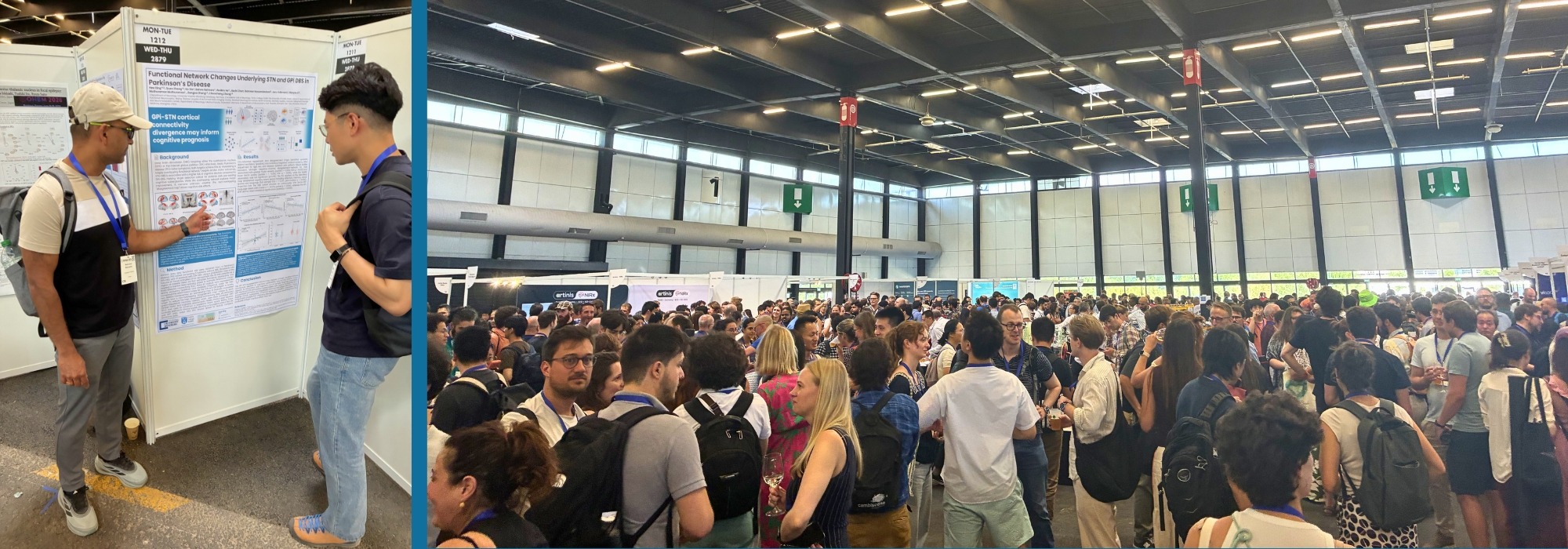
Can brain imaging help identify the most suitable deep brain stimulation (DBS) target for individual Parkinson’s patients? At the Annual Meeting of the Organization for Human Brain Mapping (OHBM) 2026 in Bordeaux, ReTune researcher Hao Ding presented new findings that bring this goal one step closer. His research shows that different DBS targets influence cognitive brain networks in distinct ways, opening new opportunities for more personalized treatment strategies.
Different Brain Targets, Different Network Responses
DBS is an established treatment for Parkinson’s disease, with the subthalamic nucleus (STN) and the globus pallidus internus (GPi) representing two of the most commonly used stimulation targets. While both effectively improve motor symptoms, their effects on cognitive functions are less well understood.
Hao Ding presented a comparison of brain network responses to stimulation of these two targets. Using advanced imaging analyses, the study examined how STN and GPi DBS differently modulate large scale functional brain networks beyond motor control.
Imaging Biomarkers for Cognitive Networks
The work is closely linked to Hao Ding’s research within ReTune, which investigates the cognitive mechanisms underlying gait disturbances in Parkinson’s disease. Walking under cognitively demanding conditions relies on frontal basal ganglia networks that also contribute to language and executive function.
By mapping how these networks respond to DBS, the researchers have established an imaging biomarker approach that can now be applied to investigate the cognitive circuits involved in gait impairment. This offers a promising tool for understanding patient specific network alterations and monitoring treatment effects.
Toward More Personalized DBS Therapy
One of the central findings presented in Bordeaux was that STN DBS shifted patients’ language related brain network signatures in a less favorable direction than GPi DBS. The results suggest that the choice of stimulation target can differentially affect language and speech related brain networks.
Although further validation is needed, these findings highlight the potential of imaging biomarkers to support individualized DBS planning. In the future, such approaches could help clinicians select the stimulation target that provides optimal symptom relief while minimizing cognitive side effects, moving Parkinson’s treatment closer to truly personalized neuromodulation.
© Picture: TRR 295 ReTune