
Groß PR, Petersen S, Wang Z, Shamshiri B, de Maissin H, Lucas S, Gorka O, Heß L, Marco-Rius I, Mangas-Florencio L, Martins AF, Boehm-Sturm P, Zaitsev M, Zeiser R, Hövener JB, Reinheckel T, Groß O, Schmidt AB.
Angew Chem Int Ed Engl. 2026 Jul 10:e4855536. doi: 10.1002/anie.4855536. Epub ahead of print. PMID: 42429181.
Abstract
Hyperpolarized (HP) 13C nuclear magnetic resonance (NMR) spectroscopy enables real-time observation of metabolic fluxes but is typically limited to single-shot measurements due to complex preparation procedures and low experimental throughput. Here, we established a rapid and experimentally accessible workflow for temporally controlled HP measurements in living cells. Using SABRE-SHEATH at 0.4 µT, we achieved 7.7% ± 0.2% 13C polarization of 50 mM [1-13C]pyruvate within 60 s. Simple 1:50 dilution with phosphate-buffered D2O yielded cell-compatible solutions that retained 5.3% ± 0.4% polarization of 1.3 mM pyruvate without multi-step purification. Combined with a simplified agarose bead immobilization approach, this enabled four injections of HP pyruvate into the same HeLa cell population within 7 min. Under rapid (≈2 min) reinjection intervals, the pyruvate-to-lactate conversion progressively declined, whereas stable metabolic conversion was maintained at 20 min intervals with intermittent cell medium perfusion. These findings demonstrate that rapid repeated substrate delivery can transiently exhaust cellular metabolic conversion capacity. This experimentally accessible operating mode enables the study of short-term metabolic dynamics that remain obscured in conventional single-shot HP-NMR or long timescale thermally polarized NMR measurements.
Graphical Abstract
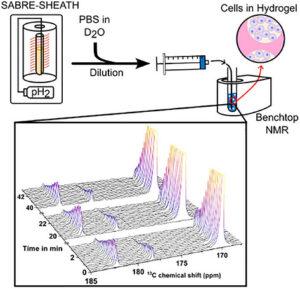
Rapid parahydrogen hyperpolarization combined with simple dilution enables biocompatible delivery of hyperpolarized pyruvate to immobilized living cells within ≈1 min. Repeated substrate injections reveal frequency-dependent metabolic dynamics, introducing a new temporal dimension for hyperpolarized NMR studies of cellular metabolism and enabling rapid probing of short-term metabolic responses.